
Paperless Business Cards: 4 Steps to Cut Carbon for ESG
Business cards are one of the most overlooked single-use supplies. Four steps, from taking stock and going digital to handling staff changes and reporting, turn paperless business cards into visible ESG action.
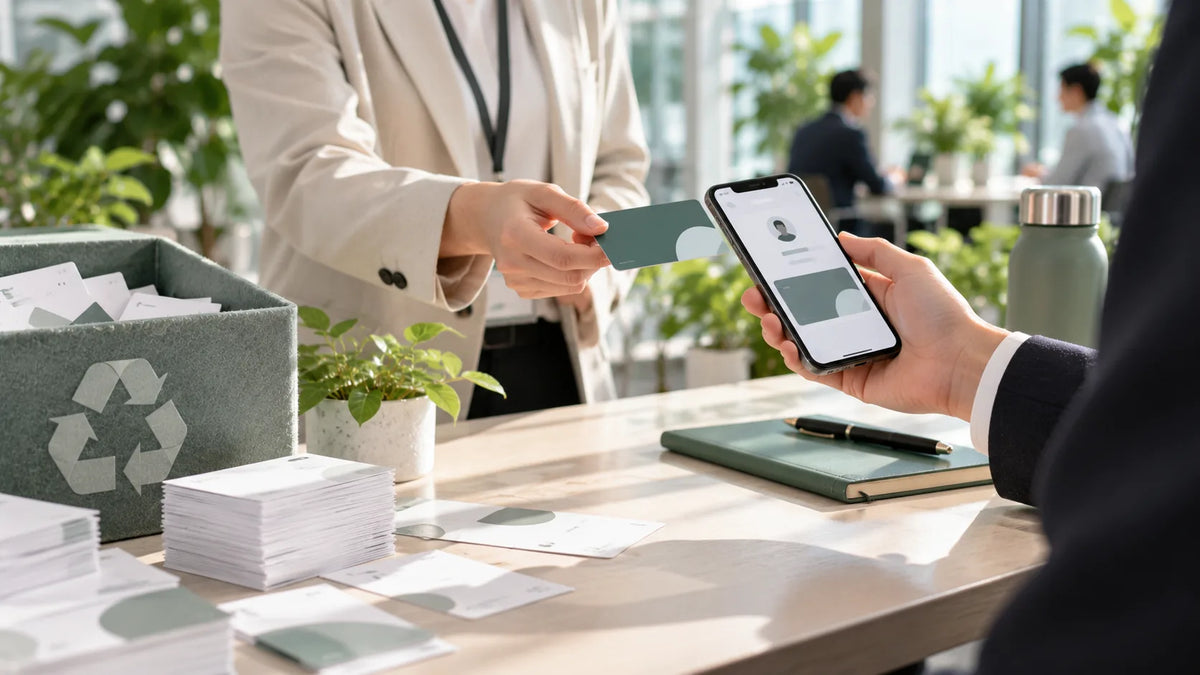
When companies talk about cutting carbon, most people think of electricity and transportation first. Business cards rarely make the list. But do the math: how many boxes do you reprint each year for new hires, promotions and redesigns? And how many printed cards go straight to the trash because someone left or their details changed? It adds up to a steady stream of waste that’s easy to fix. These four steps help your company turn paperless business cards into a visible, well-documented ESG initiative.
Step 1: Take Stock and Set a Baseline
Without a baseline, you can’t prove change. Start by gathering data from the past year:
- How many boxes of business cards the company printed, and the average per employee
- How many were discarded due to title changes, rebrands or departures
- The time and money spent on printing, shipping and inventory management
These numbers don’t need to be precise at first. What matters is measuring the same way before and after, so the results you report are convincing.
Step 2: Replace One-Off Printing with Digital Business Cards
A digital business card lives online and is shared via link, QR code or NFC card. Updates happen online, so there’s no need to reprint a whole box to change one line. Recipients can save it straight to their phone contacts instead of forgetting it in a card holder.
If face-to-face exchanges still call for something physical, pair it with a reusable NFC business card: tap the card to a phone and your digital business card opens. One card lasts for years, and you don’t need a new one when your details change.
Step 3: Build Staff Changes into the Process
Business card waste peaks at onboarding, transfers and departures. With the SPIDERCARD for Business admin console, new hires can get their card on day one, and cards can be deactivated the moment someone leaves. With SPIDERCARD, for example, you can unlink a departing employee’s NFC card in the admin console and reassign it to a new employee, so you don’t even need to make a new physical card.
Step 4: Put the Results in Your Sustainability Report
Cutting paper and printing is only the beginning. Tabulate your print volume, discarded cards and related costs before and after the switch, and you have a concrete, verifiable action item for your sustainability report, not just a slogan.
For a quick sense of scale, try the paperless impact calculator on the SPIDERCARD for Business page. Enter your team size and how many cards each person uses per year to see the estimated carbon reduction. Actual reductions will vary with paper, printing and delivery conditions.
Good sustainability isn’t a one-time megaproject. It’s a choice people are happy to keep making every day.
Getting Started: Begin with Your Most Client-Facing Teams
Roll it out department by department. Start by moving the most client-facing teams, such as sales and customer service, to digital business cards, while keeping a small supply of printed cards for special occasions. That way you balance environmental goals with real-world needs. Further reading: Going Paperless at the Office: Start with Business Cards and Docs.